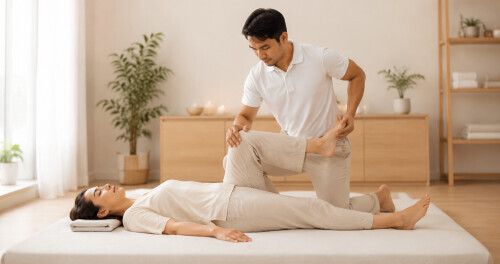
If you have only ever had a massage lying face down on a table with oil and a warm blanket, Thai massage is going to feel unfamiliar in the best way. You stay dressed. There is no oil. You are on a padded mat on the floor rather than a table. And instead of lying still while someone works on you, your therapist moves you.
It is one of the oldest forms of bodywork still practised, and it has a reputation for leaving people feeling taller, looser, and more awake than when they walked in. Here is what actually happens in the room, who it suits, and the one thing worth checking before you book Thai massage anywhere in London.
What Thai massage actually is
Thai massage works along lines that run through the body, using steady compression from the palms, thumbs, and forearms rather than the gliding strokes of a Swedish or therapeutic massage. Layered into that compression is gentle joint mobilization and a series of assisted stretches, where your therapist moves your arms, legs, hips, and spine through their range for you.
The simplest way to picture it: someone doing your stretching on your behalf, with deep tissue pressure underneath. You are not working. You are being moved.
Because the pressure comes through the therapist's body weight rather than their fingertips, it tends to feel broad and firm rather than sharp. People who find deep tissue massage too pointed often get on well with Thai.
What happens in the room
The practical differences are the ones that catch people out, so it is worth being specific.
You stay dressed. Wear loose clothing you can move in, such as leggings or joggers with a t-shirt. Avoid jeans, belts, and anything with a stiff waistband. There is no draping and nothing to undress for.
No oil or lotion. Nothing is applied to your skin, so there is nothing to shower off afterwards. This is part of why Thai fits so well into the middle of a working day.
You are on a mat, not a table. Thai massage needs floor space so your therapist can move around you and use their own body weight and leverage. Arrive a few minutes early to settle in.
You will be asked questions first. A proper session starts with a health history, not with hands on. This matters more than it sounds, and we will come back to it.
What it actually feels like
Firm, rhythmic, and surprisingly calming. The compression has a steady, wave-like quality that many people find more meditative than a table massage, and the stretches are slow rather than sudden.
It should not hurt. There is a difference between the satisfying pull of a good stretch and pain, and your therapist works to the first and stops well short of the second. Say something the moment anything feels like too much. Nothing about Thai massage requires you to push through discomfort.
Afterwards, most people feel loose and energised rather than sleepy. That is the biggest practical difference from an oil massage, and the reason Thai suits a lunch break where a hot stone session really does not.
You may notice mild next-day soreness in whatever was tightest, in the same way you would after a proper stretching session. It passes within a day.
Thai massage or the massage you are used to?
They solve different problems, and the honest answer depends on your complaint.
If your issue is stiffness and restricted movement, hips that will not open, hamstrings that have not been long since school, a back that protests when you twist, Thai is usually the better fit. Assisted stretching reaches those tissues in a way that table work struggles to.
If your issue is a specific knot, a sore spot, or one angry muscle, a therapeutic massage is the more precise tool. Oil and direct technique let a therapist work a small area thoroughly.
If you are mainly after deep relaxation and warmth, hot stone massage will serve you better than either.
Plenty of people alternate. There is no rule that says you have to pick one and stay with it.
Who Thai massage suits particularly well
Desk workers and drivers, whose hip flexors shorten through the day. Parents, who spend months carrying, feeding, and lifting on one favoured side. Runners and lifters, who accumulate tightness faster than they stretch it out. Anyone who dislikes the undressing and oil of a conventional massage, for whatever reason, and has therefore avoided bodywork altogether.
You do not need to be flexible. Being inflexible is not a disqualification, it is generally the reason to book.
When Thai is not the right choice
Thai massage is not appropriate during pregnancy. The depth of compression and the assisted stretching are not suited to a pregnant body, and we do not offer it to pregnant clients. Prenatal massage is designed for exactly this and is a completely different treatment. Thai is a good one to come back to afterwards, once your care provider is happy for you to do so.
Beyond pregnancy, be cautious if you have had recent surgery, an acute injury, osteoporosis, joint instability or hypermobility, uncontrolled high blood pressure, a heart condition, or a history of blood clots. None of these is automatically a no, but every one of them is a conversation to have before your session rather than during it.
Why the practitioner matters more than the technique
This is the part worth reading carefully if you are comparing Thai massage options in London.
Thai massage is not a regulated title in Ontario. Anyone can advertise it, and rates around the city vary enormously, which usually reflects who is delivering it rather than what you are receiving.
When Thai massage is delivered by a Registered Massage Therapist registered with the College of Massage Therapists of Ontario, several things come with it. A health history is taken and screened before any hands-on work. Treatment notes are kept. There is a regulatory college you can go to if something goes wrong. And your receipt is one your extended health plan can process.
That last point changes the arithmetic more than people expect. A cheaper session you pay for entirely yourself can easily cost you more out of pocket than a higher-priced session your benefits contribute to. If you have massage coverage through work and you are not using it, you are leaving money unclaimed.
Two caveats we would rather you hear from us. Massage therapy in Canada is not exempt from HST, so 13% is added to your session, and most plans reimburse the pre-tax amount. And coverage varies a lot between plans, so it is worth confirming your percentage, your annual maximum, whether there is a per-visit cap, and whether your plan asks for a doctor's note. We wrote more about how this works in our post on whether hot stone massage is covered by insurance in Ontario, and the same logic applies here.
Questions we get asked
How long should my first session be?
Sixty minutes is enough for a genuine full-body session and is where most people start. Ninety is worth it if you already know you carry a lot of tension, or if you want unhurried time on the hips and low back rather than a pass over everything.
Should I eat beforehand?
Not immediately beforehand. Thai involves compression through the abdomen and twisting through the torso, which is uncomfortable on a full stomach. An hour's gap is plenty.
Can I bring my baby?
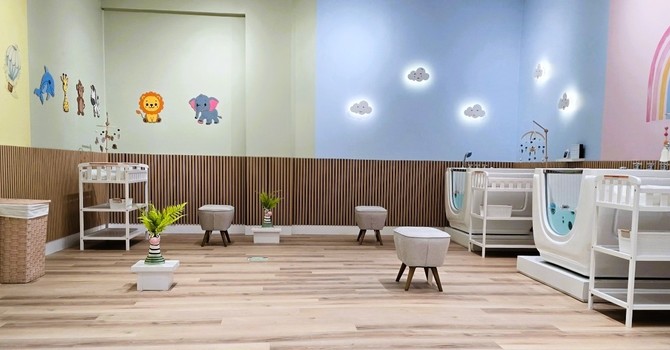
Thai massage is a one-on-one adult session and needs your full attention, so it is not one to bring a little one along to. If you are looking for something you can do together, our baby and family services are built for that.
How often should I come?
If you are working on long-standing tightness, every two to three weeks for the first couple of months holds the change better than a single session, then a monthly visit to maintain it. Your therapist will give you a realistic answer after seeing how your body responds.
Thai massage at Dolphin Dive
Our Thai massage sessions are delivered by Ajay Singh, a Registered Massage Therapist, at our studio inside ActivityPlex on Commissioners Road East in London, with free parking on site. Sessions are 60 or 90 minutes, every appointment produces a claimable receipt, and direct billing is available to most major insurers.
If you are not sure whether Thai is the right fit for what is bothering you, say so when you book. It is a better use of your session to be pointed toward the right treatment than to be talked into this one.
Read more about Thai massage at Dolphin Dive or book a session online.