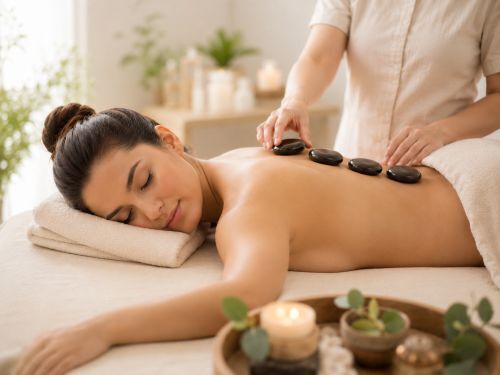
The short answer: it depends entirely on who is holding the stones. Hot stone massage delivered by a Registered Massage Therapist is claimable under most extended health plans in Ontario. The identical treatment delivered by an esthetician at a spa is not. Same stones, same heat, same hour on the table, completely different outcome when you submit the receipt.
That distinction catches a lot of people out, because almost nobody advertising hot stone massage makes it obvious which one they are selling. Here is how to tell before you book.
Why the practitioner decides the coverage
Extended health plans do not reimburse treatments. They reimburse practitioners. Your plan has a line for massage therapy, and it pays out when the person who treated you is registered with the College of Massage Therapists of Ontario.
Hot stone work sits comfortably inside the scope of massage therapy. Applying heat to soften tissue so it can be treated more effectively is ordinary therapeutic practice, not a separate discipline. So when an RMT uses stones during your session, you are receiving massage therapy, and your receipt reflects that.
When an esthetician uses stones, you are receiving a spa service. It might be excellent. It might feel identical. Your insurer will not pay for it, because the person delivering it is not a registered health professional.
What your receipt has to show
The College sets out what belongs on a massage therapy receipt, and it is worth knowing so you can spot a receipt that will get rejected:
- The date of your appointment
- Your name
- The name of your RMT
- The amount paid
- The signature and registration number of your RMT
- An HST number, where applicable
Services within the scope of massage therapy are described on the receipt as massage therapy treatment. Your RMT can add detail if you want it, but that core information is what your insurer is looking for. If a receipt is missing the registration number, that is usually the reason a claim comes back denied.
How to check your own plan in five minutes
Coverage varies more than most people expect, so it is worth looking rather than assuming.
Find your annual massage therapy maximum. Somewhere between $300 and $1,000 a year is typical, though plans differ widely. This is a combined pot for all massage therapy, so hot stone draws from the same limit as any other massage.
Check your reimbursement percentage. Many plans cover 80% of each visit rather than 100%. On a $135 session that is roughly $27 out of pocket.
Check whether you need a doctor's note. Some plans still require a physician referral before they will pay for massage therapy at all. It is less common than it used to be, and it is a quick thing to sort out in advance rather than after you have paid.
Ask about direct billing. If your clinic can bill your insurer directly, you pay only your portion at the desk instead of paying in full and waiting for reimbursement.
A note on tax
Massage therapy in Canada is not exempt from HST, so 13% is added to your session. This surprises people, since several other regulated health services are exempt. A federal petition asking for the exemption was presented to Parliament in January 2026, and as of the government's response it was under review rather than granted.
Worth knowing for two reasons. Your all-in cost is higher than the posted rate, and most plans reimburse the pre-tax amount, so the tax portion generally stays with you.
What is not covered, whoever delivers it
Even with an RMT, a few things fall outside what your plan will pay:
- Gift certificates. Insurers reimburse treatment you received, not credit you purchased. The claim goes in after the appointment, by the person who had it.
- Someone else's appointment. You can only claim for yourself and your dependents, even if you paid.
- Sessions beyond your annual limit. Once the yearly maximum is used, the rest of the year is out of pocket.
- No-show and late cancellation fees. No treatment happened, so there is nothing to claim.
When hot stone is not the right choice
Coverage aside, heat is not appropriate for everyone. Hot stone is not suitable during pregnancy, and it is generally avoided where there is reduced sensation, a circulatory or cardiovascular condition, an acute injury or active inflammation, or a skin condition affecting the area being treated.
This is one of the practical arguments for booking with a registered practitioner. An RMT takes a health history and screens for these things before any heat goes near you. If hot stone is not right for you, they will say so and suggest something that is. If you are pregnant, prenatal massage is designed for exactly that, and hot stone is a good thing to come back for afterwards.
Hot stone massage at Dolphin Dive
Our hot stone sessions are delivered by Registered Massage Therapists, so every appointment produces a claimable receipt and direct billing is available to most major insurers. Sessions are 60 or 90 minutes, at our studio inside ActivityPlex on Commissioners Road East in London, Ontario, with free parking on site.
If you would rather try it before committing to a full session, you can add heated stones to a therapeutic massage you have already booked. It adds 15 minutes and focuses on the back, shoulders and feet.
See hot stone massage sessions and pricing, or call us at 226 984 8000 and we will help you work out which session length suits what your body is asking for.
Coverage details vary by plan and by insurer. The figures above are general guidance, not advice about your specific policy. Your benefits provider is the only source that can confirm what your plan covers.